How to tune a car with a laptop
Your car's running fine, but you know there's more power hiding under that hood. Maybe the throttle response feels sluggish, or you've added performance parts that need proper calibration. Professional tuning shops want $500 to $2,000 just to optimize your ECU, and that's before any follow-up adjustments.
Here's what they don't advertise: with a laptop, the right software, and some careful learning, you can unlock that same performance yourself. Modern cars run on computers, and those computers speak a language you can learn. The barrier between you and custom tuning isn't technical complexity anymore, it's just knowledge and the right tools.
Laptop tuning puts you in the driver's seat of your car's brain. You control fuel delivery, ignition timing, boost pressure, and dozens of other parameters that transform how your engine performs. Whether you want better fuel economy, sharper throttle response, or maximum power from your modifications, the path starts with understanding how accessible ECU tuning has become.
Can I tune any car with just a laptop and basic knowledge?
The honest answer depends on your definition of "tune" and "basic knowledge." Most cars built after 1996 have OBD-II ports that allow some level of computer access. But having access and having the ability to safely modify parameters are vastly different things.
Your success depends heavily on your specific vehicle. Popular platforms like Subaru WRXs, Honda Civics, and GM LS engines have massive tuning communities with well-documented procedures and readily available software. Try tuning a newer Mercedes or BMW without specialized tools, and you'll hit encryption walls that basic software can't breach.
Basic knowledge gets you started, but it won't get you far. You need to understand how engines work, not just how to click buttons in software. Knowing why you're adjusting ignition timing matters more than knowing how to change the numbers. Without this foundation, you're essentially playing Russian roulette with your engine.
How car tuning with a laptop works
Car tuning with a laptop works by connecting tuning software to the vehicle’s ECU via an OBD or USB interface. The software reads engine data, allowing you to adjust fuel maps, ignition timing, and boost settings. Once modified, the new tune is flashed back to the ECU to optimize performance.
The process involves reading your car's current programming, modifying specific values, and writing these changes back to the ECU. It sounds simple because conceptually, it is. The complexity comes from understanding what each value does and how changes cascade through interconnected systems.
Understanding Engine Control Units (ECUs)
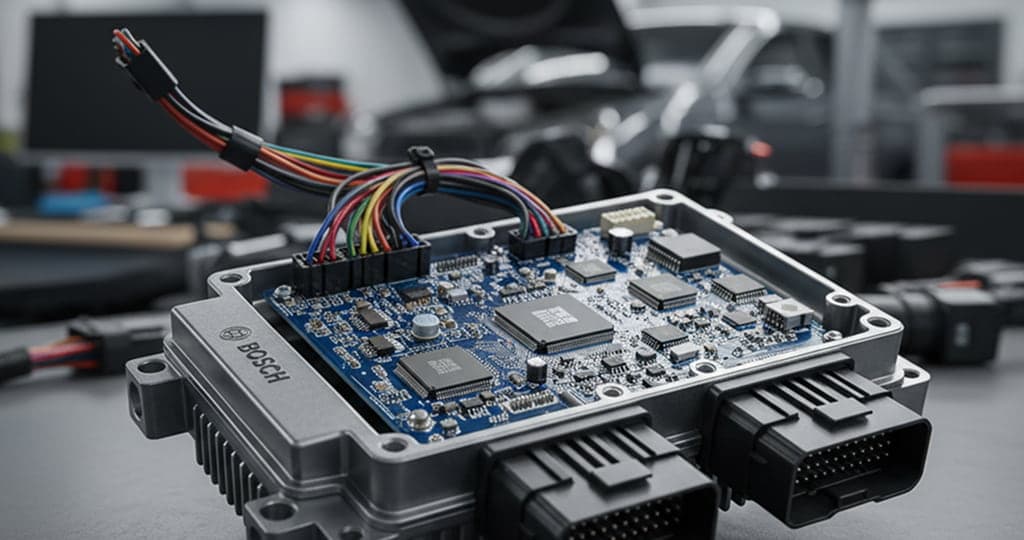
Your ECU is essentially a specialized computer running software that controls engine operation. It takes inputs from dozens of sensors including air temperature, coolant temp, throttle position, and oxygen content, then uses programmed maps to determine fuel delivery, ignition timing, and other critical parameters.
Think of ECU maps like recipes. The factory recipe might call for conservative ingredients to ensure your engine lasts 200,000 miles in any climate. Tuning lets you adjust that recipe for your specific conditions and goals, whether that's more power, better economy, or both.
If you want to unlock your ECU's potential? MotorMia uses AI to analyze your vehicle to recommend compatible ECU solutions like piggyback modules, flash tuners, or standalone systems. Mia shows which upgrades work with your engine, real pricing from trusted suppliers, and required supporting mods.
You can skip the forum confusion and get personalized ECU recommendations for your exact setup. Let Mia guide you to the right solution.